
Part 1: Writing The Corus Wave
Posted: 14-03-2026
This is part 1 of a series of blog posts I'm writing about the process of making my debut graphic novel The Corus Wave. In this blog post: writing The Corus Wave, coming up with the SEED and the HEART, words of wisdom, developing the idea, pacing the mystery, editing, and turning the outline into the script. I will be going into excruciating detail about every part of my writing process - I hope it's interesting! I've separated everything into chapters so feel free to skip through.
This will include some spoilers for The Corus Wave so watch out!
CHAPTERS:
PREFACE
PART 1: EARLY STAGES, THE SEED AND THE HEART
PART 1.5: LESSONS
PART 2: OVERVIEW AND OUTLINE
OUTLINE
THE UMBRELLA PLOT AND THE CORE PLOT
PACING THE MYSTERY
EDITS/CHANGES
PART 3: THE SCRIPT
PREFACE
I spend a lot of time in the writing phase, mostly because I really love writing.
But I do strongly believe that the story is the most important part of a comic. I've read plenty of comics with absolutely gorgeous artwork which was rendered completely ineffective thanks to weak and flimsy writing, a story I didn't care about or was impossible to parse. Similarly, there are plenty of comics with a 'less polished' art style which, thanks to strong writing, are some of my favourites. I do believe the artwork is important - incredibly important - to the storytelling, but beautiful artwork with no substance will always be less memorable to me than an incredible story rendered in stick figures. Yes, this is also something I tell myself so I stop torturing myself about the quality of my drawing.
I spent a long time hammering out the story of The Corus Wave, writing, editing, and rewriting: I know that a lot of cartoonists prefer to work out their story through drawing it – usually in thumbnailing – but just as a matter of preference I prefer to work most of the story out in text. Writing comes more easily to me, and I also find it easier to make large scale edits to the story this way. I was over a year into conceptualising The Corus Wave before I finally started to draw it. Let me tell you a little (well actually, a lot) about my process.
PART 1: EARLY STAGES, THE SEED AND THE HEART
I came up with the original concept for The Corus Wave when thinking about a story for my 2023 Short Box comic, and I got a decent way into the ideation before realising that this story would be far too long to finish in time for the fair (the comic I ended up making instead was Avoiding Work at the Sunny Day Cafe and Bakery). The Corus Wave was resurrected when Avery Hill approached me about publishing a graphic novel, and I had it ready in the chamber to pitch.
Let's start by travelling back in time to 2021, when I was accepted into the Short Box Comic Fair for the first time and found myself in the position of writing my first longer-form comic, aiming for 25-30 pages. The comics I had made previously reached a maximum of 4 pages and the longer stories I had written were vast unfinished epics, so I struggled at first to work out how to approach this mid-length. I started thinking about styles of short narratives which I enjoyed and which could be self contained and satisfying. I was drawn to the SCP Foundation - tales of strange and eerie creatures/objects written about as case-files from a shady institution. Thus the 'SEED' (no pun intended) for SPEIROCHORY was born - a eerie story about 3 strange seeds, told as a case file.
When I was accepted for SBCF again in the following year I began my ideation similarly - thinking of what 'kind' of story I wanted to tell: I decided I wanted to write a treasure-hunting story about some kind of fictional geology. I love scavenger hunting films where people solve cryptic clues and riddles to discover some hidden secret - see National Treasure, The Da Vinci Code, St Trinian's 2, and I wished there was more media like that. I think that's always a strong place to start when writing something - what story do I want to read, do I want to exist that doesn't exist? And as for the fictional geology aspect, I studied geology for some time and am very passionate about it as a subject, I think it's under-represented in speculative science plus rocks are cool! Rocks can be really interesting and cool!!
So this was my starting point for The Corus Wave - the SEED - a scavenger hunting story about fictional geology. Next was to expand upon the seed.
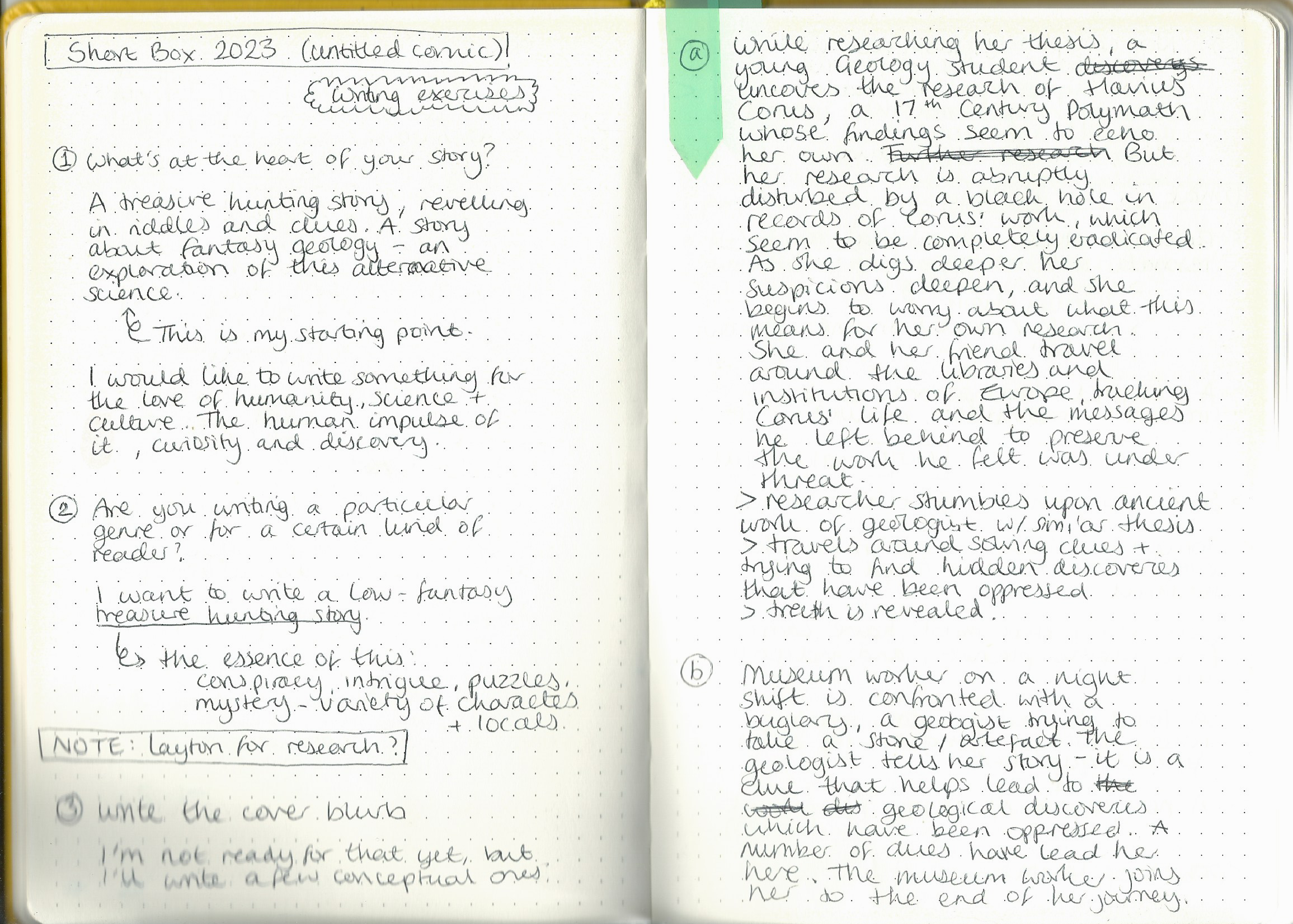
I started by looking at writing exercises and questions to ask myself about the story, what I wanted to achieve and what I wanted it to be. I like to work things out by writing them down on paper, my ideas become far more solid that way. Annoyingly I can't find the website where these particular questions are from, but they were very useful to me. Question 1 was "What's at the heart of your story?" I wrote down my answer as a stream of consciousness and I quickly found my main theme:
"I would like to write something for the love of humanity, science + culture. The human impulse of it, curiosity and discovery."
Question 3 was "write the cover blurb". This scared me because I didn't feel at all ready for that, I didn't know my story at all. Instead I decided to write down a number of premises as they came to me, anything I could think of. At this starting point I find it useful to write a lot of ideas down without being precious about them instead of trying to formulate a single perfect idea, this stops me from getting stuck. Funnily enough, the first idea I wrote down was the one I ended up pursuing (although with a few small changes – I decided to reign it in from a europe-wide exploration), I even became attached to the placeholder nonsensical name I wrote down for the old scientist:
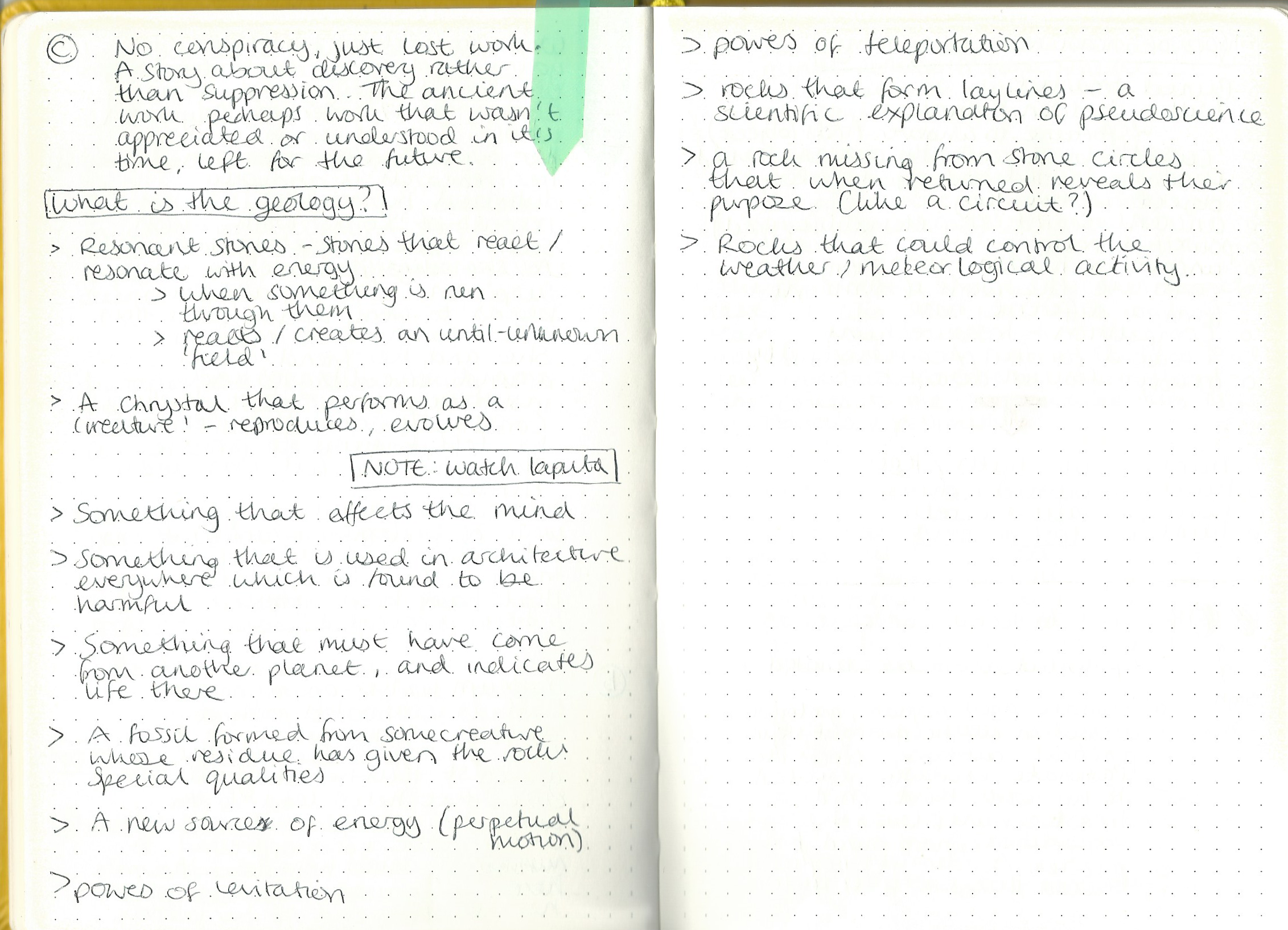
I also listed every idea I could think of for what the 'fictional geology' in the story could be, and similarly ended up settling on my first idea. This is definitely telling of something although I don't know if I could say what.
Aside from these writing exercises I did some investigation into the 'genre' - I made lists of types of treasure hunting stories and separated them into categories – this kind of arbitrary classification is often a part of my research for some reason and honestly the results are not worth sharing, but it did give me space to think. I watched/read/played examples of the genre I could find, which was actually not that many! I'm sure more exist but they aren't easy to locate. I was trying to understand the tropes of the genre so I could play on them in an educated way, but I'm honestly not sure how much this really helped me. Some media for research: National Treasure, The Da Vinci Code, Indiana Jones, Professor Layton (what a good excuse to replay these games), Mr. Penumbra's 24-Hour Bookstore.
As I was closing in on the story I wrote a list of goals for my book. This was the list:
- Make a fun and exciting mystery
- Have clever clues and puzzles
- Cool factor
- 3 dimensional drawing**
- Pushed perspective**
- Detailed - not lazy drawing**
- Love letter to geology
**(drawing related - to be discussed in Drawing The Corus Wave)
This list was really useful to me, it helped me understand my priorities and kept me grounded. I will definitely be doing this for my future projects.
PART 1.5: LESSONS
Before I go on, I want to mention the lessons and words of wisdom which helped guide me through the writing process. When I first thought about writing this story in 2022, I felt woefully underprepared. I've always enjoyed and taken an interest in writing, but I felt like I needed more of an education in it to know what I was doing. I think I took this a bit too far thanks to my lack of confidence, I find it easy to get stuck in preparation paralysis, but I did find a lot of helpful things.
I discovered that Brandon Sanderson had uploaded his 2020 Creative Writing Lectures at BYU on Youtube, and so I watched through these lectures and took notes. Although not everything was relevant to me, there were a lot of useful ideas.
In his second lecture he talks about promise, progress and payoff.
Promise is about establishing your premise well. This rung very true with me – I've read comics which I've found really disappointing because they made the wrong promise, I was excited to read the comic that I had imagined from the blurb/title/premise, but the actual comic turned out to be something entirely different. Maybe I could have enjoyed the comic if I was ready to read what it actually was, but as it was I was left wanting. Making the right promise colours the entire experience of your book.
Progress is about creating a page turner and the sense that things are building to something the reader is excited to see/discover. Sanderson asks 'why are people turning the page?' what questions do they want answered? He says stories can be boring if the current progress feels like a diversion and the reader is waiting to get back to the 'main' plot. I think that keeping up a sense of intrigue is especially important in writing a mystery comic like The Corus Wave.
Payoff is about providing a satisfying conclusion, fulfilling the promise. The Corus Wave is about finding a lost scientific theory and investigating a strange fossil, so the payoff is discovering that lost theory and truth about the fossil. Of course you can give the audience something different to what you promised, but Sanderson warns that it's risky, you have to convince them that it's fulfilling, that it's better.
Sanderson also talks about the 'cool factor' - basically, the principle that that you should always do the coolest version of the thing, and not hold yourself back. This was definitely something I had to remind myself of, and stop myself from pulling my punches. It's about thinking 'what would be the coolest, most exciting thing to happen next in the story? Why shouldn't I do that?'. I encouraged myself to make more grand and intricate puzzles in cooler locations. At some point I happened to watch an interview with director Taika Waititi where he was talking about his process, and he said something like, when a scene becomes boring to make he changes it, moves somewhere else, makes it exciting again. I think if the writing process is boring, if you're working on a scene which is a chore, it's probably a chore to read too, so make sure to enjoy yourself.
In his lectures Sanderson mentioned the Writing Excuses podcast, a podcast he makes with other writers (although as his career skyrockets he appears in episodes less and less). These are short episodes about writing tools and techniques and there are hundreds of them. I would look up key words ('mystery', 'dialogue', 'character') and download random episodes that sounded interesting, then listen to them on a walk. Sometimes there would be really useful tools/advice that I could apply to my own work, and sometimes I found their discussions completely annoying, but either way my mind would wander to thinking about my own story. Sometimes I'd have to pause the podcast because I was missing it all while imagining new scenes or characters. It was a good way to make space and time to think about the story and prompt new ideas.
My last word of wisdom is about originality. I often find myself worrying about the originality of my stories and I think this is common. What I have concluded is that your voice - your perspective - is always original, because it's coloured by your unique experiences. The way a wealthy Japanese businessman pictures a house looks completely different to how an Italian farm labourer pictures a house. In fact, two Japanese businessmen will not imagine exactly the same house. The thing you write will say things about your perspective and who you are if you like it or not, and it will speak to people who share things with you. For example, in The Corus Wave I based the characters off of people I know, the experience of University off of my experience of University - these people, relationships and experiences are unique to me. To trespass into the subject of drawing The Corus Wave, every aspect there is similarly informed by my experience of the world, more intentionally in the Cornish-inspired landscape and unintentionally in things like what people wear and what dresses an interior. I've never really watched or read something that reminded me properly of home, of growing up in Cornwall, and I wanted to make it possible for someone to recognise their life through my eyes. Basically, don't worry about it – this isn't a comity-written marvel film, you have a voice, just embrace it.
PART 2: OVERVIEW AND OUTLINE
As I formulated my plot, I began to write my outline. I topped my outline document with an OVERVIEW. The overview is a summary of the important parts of the comic, and I believe they are usually used for pitching stories. In the overview I created for myself I wrote one paragraph summarising the plot, then descriptions of the important characters.
"A geological treasure hunt story. Geology master's student Lori is researching the formation of a peculiar fossil, and comes across a theory from a polymath whose work is mostly lost. She decides to go to his birthplace to investigate, and uncovers a series of clues he left behind in his architecture to preserve his work for future generations."
My early character descriptions:
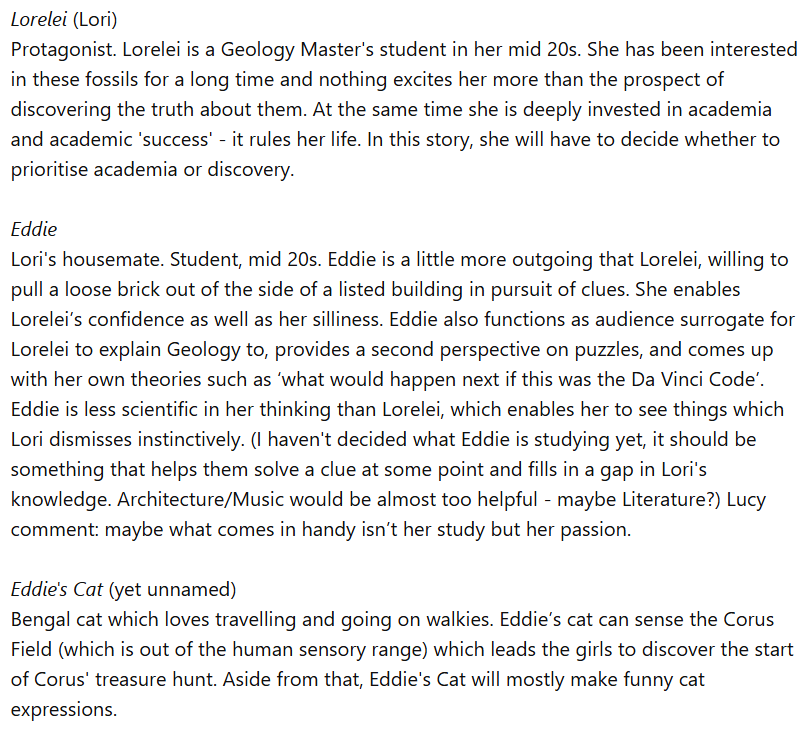
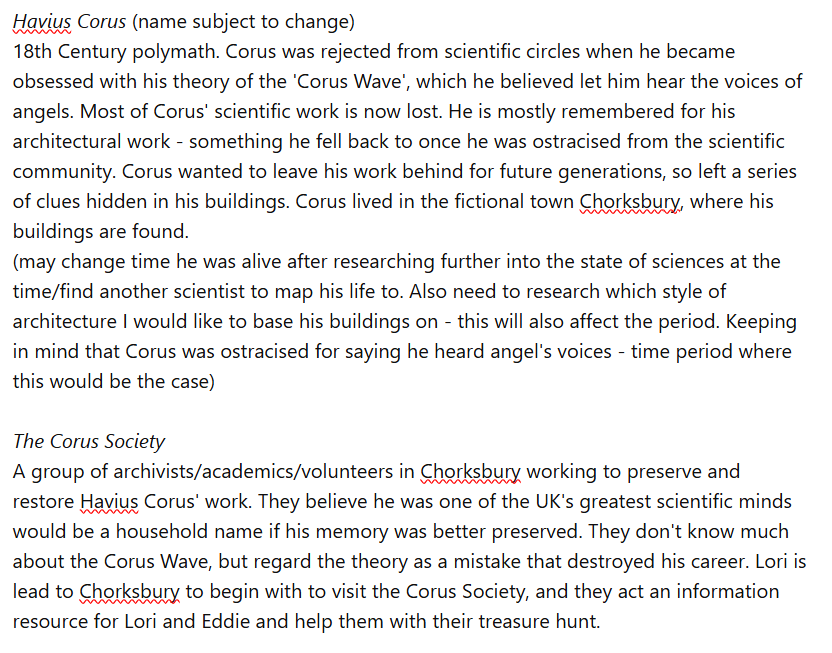
When I actually pitched the comic I wrote a more detailed plot synopsis, five paragraphs describing the plot, characters, and heart of the story. I suppose I will share it for completion's sake even though I find it pretty embarrassing to read back...
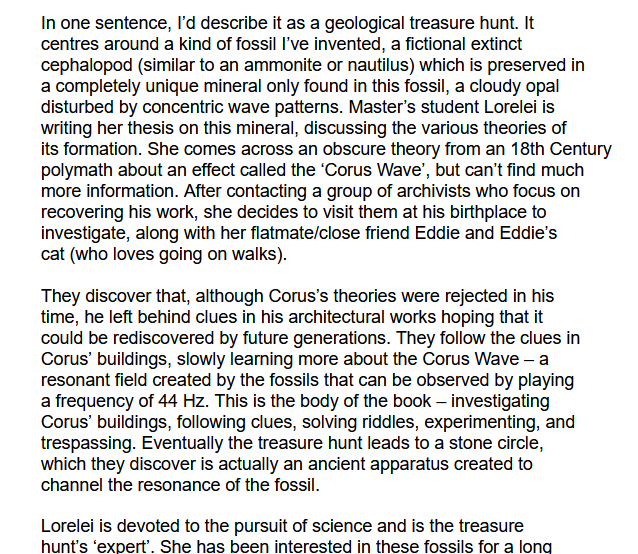
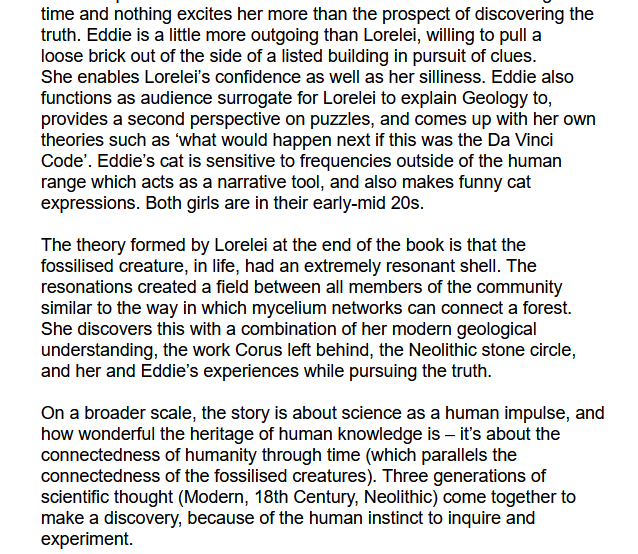
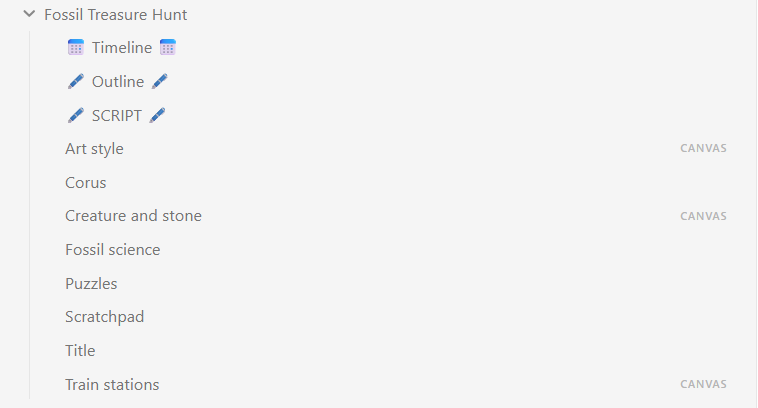
Oh, and if you're interested, the writing software I use for comic projects is Obsidian. I like how you can easily switch between everything and have a bunch of text files, moodboards etc in one place. Here's what my folder for The Corus Wave looks like!
OUTLINE
I write my outlines as a play-by-play of everything that happens in the story in bullet point form. I listed the events of the story interspersed with snippets of scenes and dialogue which I had in mind already – these early scenes which I had imagined when first conceptualising the story acted as anchors when I found myself drifting. I tried to not get caught up in the details and just left placeholders if I got stuck to keep the ideas flowing - in this example I've left placeholders for Geological names and information which I would research and decide on later:
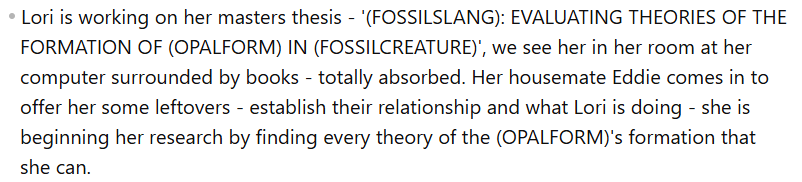
Most puzzles were also very vague at this point - I would write 'this information is found hidden here' and leave how it was hidden for later.
THE UMBRELLA PLOT AND THE CORE PLOT
Brandon Sanderson talks about the 'umbrella plot' - which is the premise of your story (e.g a woman moves to the big city) - and the 'core plot' which is what the story is actually about (e.g people falling in love, urban vs rural living). I also defined these in this document.
The Umbrella Plot:
Lori wants to find out about Corus' lost theory to help write her thesis. On a larger scale she would like to find out how the fossil is formed. She follows the treasure hunt to do this.
The Core Plot:
Science as a human instinct
I think the human instinct towards science - towards understanding the world - is really touching. The human instinct to understand things not for profit but for curiosity. I want to demonstrate this through 3 generations of scientific enquiry coming together, and a connectedness to these other people in other times - a sense of humanity. Adjacent to this theme are the fossilised creatures - which connected to each other as a community through the Corus Field.
PACING THE MYSTERY
In university I made a puzzle box. A story unfolds as the box is explored, and the reading order is controlled by a system of ‘keys’, so certain parts of the story must be discovered before others can be revealed. For example, one clue can only be found after an allen key is discovered to open the compartment, and another requires a filter to be found before it can be read properly.
I was reminded of this system of keys while writing the mystery in The Corus Wave. It was a scavenger hunt that had been undiscovered in multiple locations for over 100 years, so it had to be believable that no one would stumble upon it. Each part of the mystery must only makes sense in conjunction with the clues found previously, and you can only really start to unravel the mystery after finding the first clue, the key, that was undiscovered for so long.
At the instigation of the mystery, the fossil and message from Corus tell our protagonists Lori and Eddie cryptically what they are looking for: Corus' lost theory, which he hid chronologically in his buildings. This is the treasure map. It also gives them the 'key', the fossil, which is the subject of his theory.
Clue 2 in the library tells them in vague terms about a scientific phenomena where a stone conducts a frequency, from the previous clue they know this stone is the fossil.
Clue 3 gives them a number, and from the previous clue they can infer that this is the frequency they are looking for.
Clue 4 can be discovered once this frequency and the fossil are put together, and rewards them with some of Corus' workings and a 'key' to unlock the next clue.
Clue 5 hints at the relationship between multiple fossils, and was an original culmination of Corus' findings, but a missing piece leads them onwards.
Clue 6, unlockable with all they have found so far, shows them to their final destination, where the 'treasure' is buried. And by putting all the pieces they have discovered into place, they come to the final conclusion - the truth, not only what Corus had discovered, but what they can understand of it through a modern lens.
Each clue builds on the previous one, creating a sense of building progress. Questions are answered but more are asked, the mystery transforms and evolves. Something I was concerned about was making the solving of the thing feel like 'work' - not just the protagonists drifting from one location to the next, instantly solving puzzles and understanding everything. I tried to achieve this with roadblocks, mistakes, and Eddie and Lori needing to each using their specific knowledge and attitudes collaboratively to work things out. I added more of this as I edited the first version of the outline and grew the story from a 50-page digital comic to a 100+ page graphic novel.
EDITS/CHANGES
When The Corus Wave was picked up by Avery Hill Publishing, I found myself with an editor for the first time. I think this prospect terrifies a lot of people, who imagine an editor bastardising all the best parts of their masterpiece. Stories are so personal and it can be hard to allow people to touch your precious baby, and I did have to learn to open my heart to accept criticism of parts of the story that I liked. But honestly, I was excited to have another, more experienced set of eyes on my work, and someone to help me make it the best version of itself. Ricky was helpful but not forceful with his feedback - Avery Hill seem to have a policy of letting the authors intentions come first rather than the horror stories you hear about books being changed completely to fit trends and audience data. Here I'll mention some of the things that were added or changed in the editing process.
The very first (SBCF) draft of this story was much, much shorter. There wasn't much room for anything other than the beats of the mystery. I definitely find plot easier to write than character, and in this version the characters had completely fallen to the wayside. After the comic got picked up I went back and thought about Lori and Eddie's character arcs, their personal responses to the mystery, and added emotional highs and lows. With the new length I could make the treasure hunt a bit bigger, too. I added two more locations: the botanical garden and the clock tower. I added an emotional low point where Lori and Eddie argue and Lori gives up the hunt. I was able to space out the pacing.
For a long time I was unsure about the 'conflict' of the story. I didn't want to add a nemesis - a bad guy who was ruining everything by being evil. It felt childish, against the spirit of the thing. But what was the antagonist? My first idea was time - the time that separated them from Corus and from the fossil, and the time that Lori was fighting against to finish her thesis, but this was pretty weak. I had a breakthrough listening to an episode of Writing Excuses. The 'homework' for that episode was to think of the driving emotion of your story, then think of what the opposing emotion to that is. The driving emotion of my story is curiosity, and I decided that the 'emotion' that opposed that was success. Lori is held back by her want for academic success, and Eddie is held back by wanting a monopoly on success. They can discover the truth once Lori stops prioritising academia and Eddie allows collaboration.
With this I added in a kind of 'nemesis' - Dr. Marley. She doesn't doing anything wrong necessarily, but she has a sinister vibe, talks condescendingly to our protagonists, and thanks to the tropes of the treasure hunting genre it is easy to interpret someone competing to solve the treasure hunt as the enemy. I used her to create some conflict and tension along the hunt, but in the end the protagonists must team up with her and combine their knowledge to find the 'treasure' - my message here being that curiosity and discovery suffers with competition and thrives with collaboration.
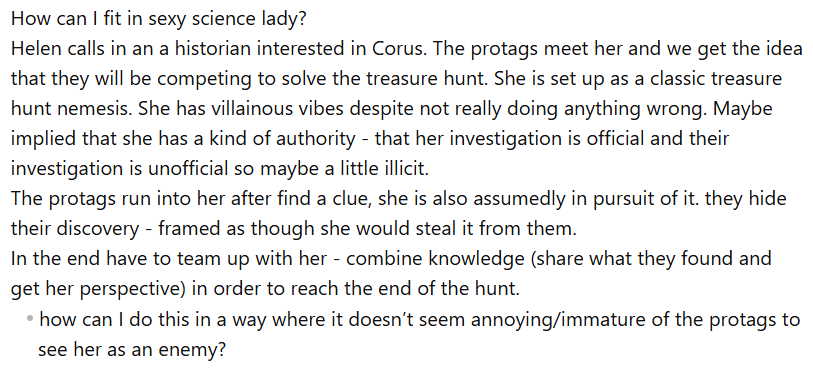
Ricky gave me a lot of great advice on the plot points above, but what was especially useful when making this kind of mystery story was checking that it made sense to someone outside of my own brain. I didn't want to over-explain things but instead found myself under-explaining them, and Ricky let me know when something was hard to understand. It was really important to me that the majority of readers would be on the same page with solving the mystery and understanding the science, so I made sure to slow down, reword, and clarify a lot of things.
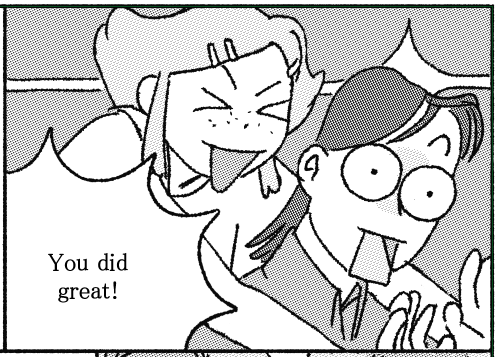
Something that I avoided changing for a long time despite my editor's recommendation was in the epilogue. Lori is giving a talk about the fossil, and afterwards Eddie says to her: "Great job professor!". Lori then clarifies that she is technically only a hobbyist. To me it was clear that Eddie calling her 'professor' was a cute nickname, and that Lori wasn't part of the academic institution, but, as my editor brought up, that line definitely left a lot of space for misinterpretation. I tried to convince myself it was fine for a long time, and in the end it was one of the very last things I changed. The problem was that Lori leaving academia at the end and pursuing knowledge free of those structures was key to the resolution of the story, and any confusion of this was muddying the core of what I was trying to say. Even though it seems small, this was the one moment I felt I had to really 'kill my darlings', I thought it was such a cute moment, and my replacement - "You did great!" - didn't quite hit the same. But yes, it was the right decision.
PART 3: THE SCRIPT
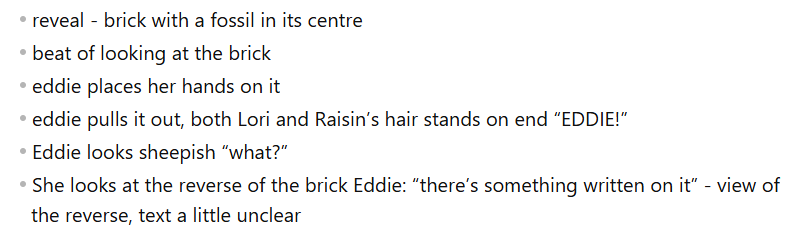
After I was happy with my outline, I moved onto writing the script. There are some predefined ways for writers to structure comic scripts for their artists, but as I'm writing for myself I can just do it how I like. Because of this I don't detail the exact layout of every page, and leave a lot of decisions for my future self to work out in thumbnailing. The only necessity is that my editor can also interpret it. Here's an example of how the script looks, and the final pages:
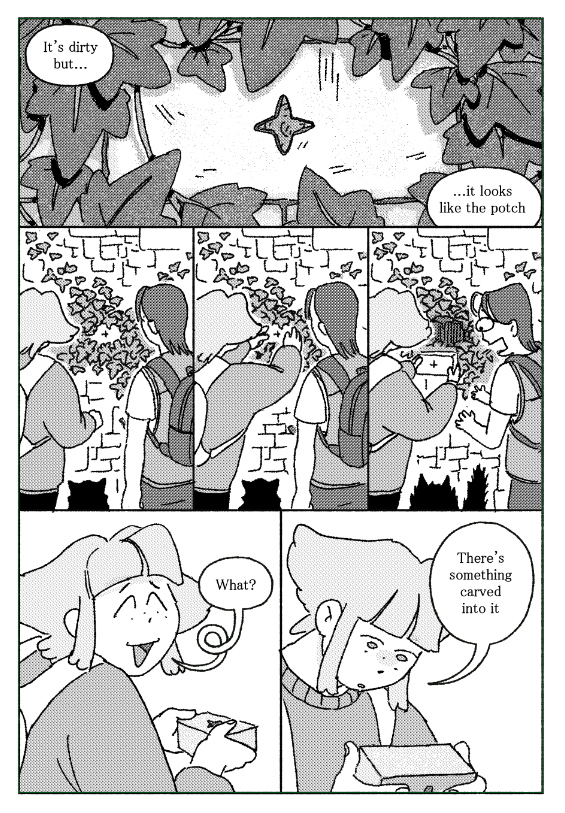
Whilst writing the script I researched to fill in the gaps I left in my outline. For example, I did some scientific research into the opalisation of fossils, and historical research to organise my timeline. I also worked out the details of the puzzles at each step in the treasure hunt.
When I first wrote my script, I didn't chop it up into pages (although I noted down when something should be over a double page spread). I went back through later and separated it out - this just works for me, I don't know if its necessarily a good idea. I used a few principles to work out how to pace my pages to create a page turning mystery. For want of better words I'm calling this 'fostering flow' - creating an environment which is easy for the reader to get sucked into:
Mini cliff-hanger:
Each page ends in a mini cliff hanger, driving the reader to turn the page to find out what happens next. This is a way to foster page-to-page flow. These three pages are a nice example:
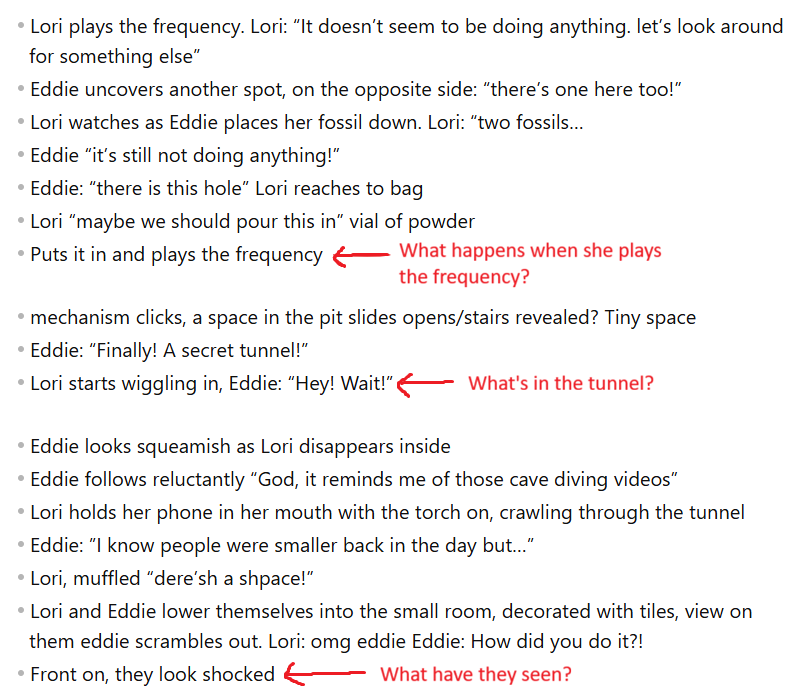
Set up and punchline:
The page starts with a 'set up' and ends with a 'punchline'. This is a way to foster flow within the page. I thought about this pretty abstractly, hopefully you can see what I mean from these examples - I've included the final pages because it might be easier to understand. The punchline isn't something funny necessarily, just that a premise of the start of the page is answered. I think it also creates a sense of progress and stability.
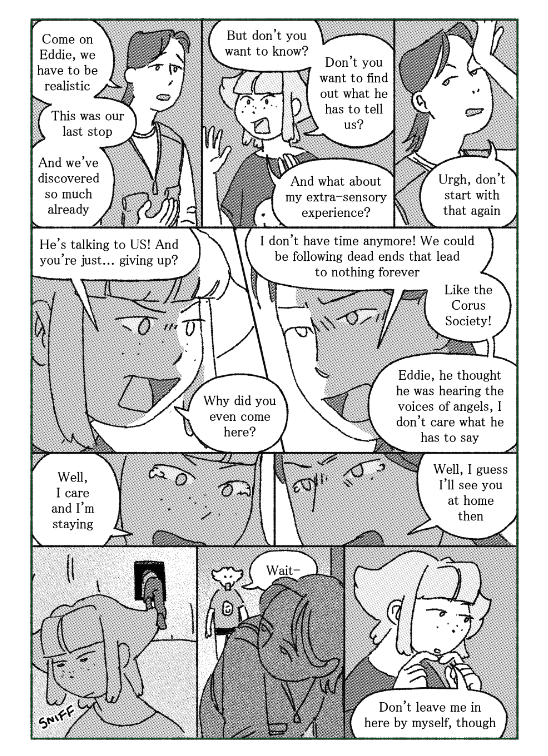
Set up: Eddie and Lori start arguing 'Punchline': They finish the argument and part ways, but Eddie doesn't want to be left alone (cliffhanger: Is Lori really giving up? What will happen to the mystery?)
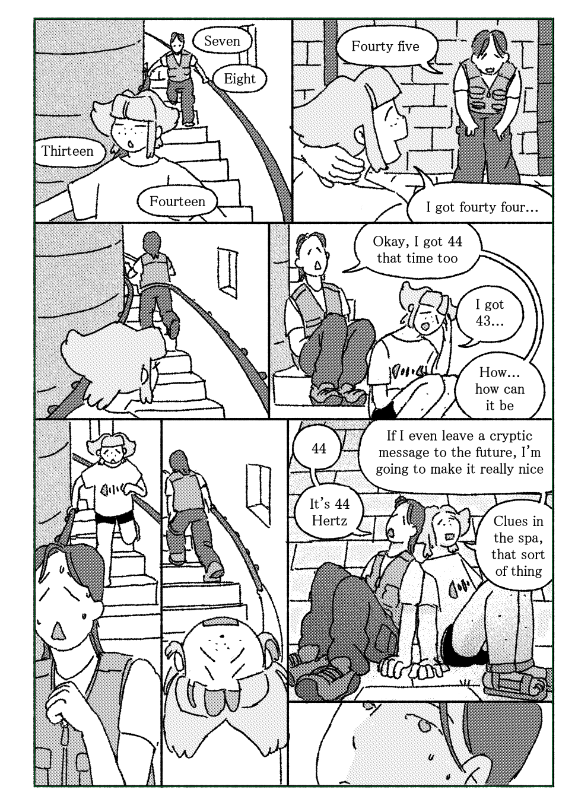
Set up: Eddie and Lori run up and down the stairs counting 'Punchline': They become exhausted, but they work out the number (cliffhanger: What has Lori seen in the last frame?)
Again, this is more of an abstract concept of a set up and punchline, but it was a good method for separating out the beats of the script into pages. To cut either of these pages off one or two panels earlier would have made the action feel a little stilted, the set-up going unanswered and the next page starting with panels that lack momentum. It would be like putting the punctuation in the wrong place.
I've received a lot of feedback that people found my comic hard to put down, which I think speaks at least partially to the success of these techniques! My favourite response was from my granny, who said something like: 'I was surprised that I actually got pulled into the story'. This is high praise.
I scrutinised, edited, and rewrote my script for a long time, but once I was finally happy with the shape of the story I moved on to the thumbnails! That's all for this blog post, I'll talk about the thumbnails, pencils, inks, tones, drawing techniques, concept art, art influences, software, and every other thing I can think of part 2: Drawing The Corus Wave.
Thanks for reading this ridiculously long block! I hope that it was at least a little interesting. If anyone ever has a question about how I wrote The Corus Wave, I imagine they can find the answer here.
- Karenza